Author: Prae Sunsermsook

  • Unit 1 Methods of Iterating: Week 1

    Excerpt from the project brief

    Find a project made by someone else that makes effective use of this tool or medium. (Make your selection in advance of your first tutorial on Jan 16, and bring it to share and discuss with your group.)

    My Reasoning for choosing p5.js

    Before I introduce my chosen tool, I’ll briefly explain why I selected it, based on what I’ve learned from Methods of Translating. During the visual exploration for this brief, I realised the limitations of the tools I usually use, like Illustrator. I wanted to visualise the ‘collapsing’ of graphic elements over time, but static software couldn’t fully convey that. 

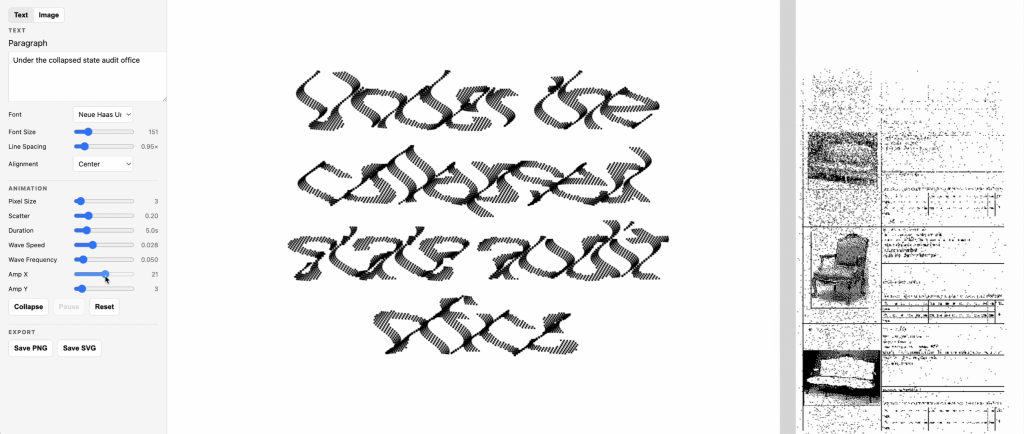
    This led me to experiment with creative coding. Since I had no prior experience, I utilised AI, or what some call ‘vibe coding,’ to develop a generative tool. Then I developed a concept for this tool that allowed me to upload images and text, which would then collapse under adjustable parameters I set. I used the resulting outputs as graphic elements in my publication.
    Collapsing App

    An interface of a collapsing tool

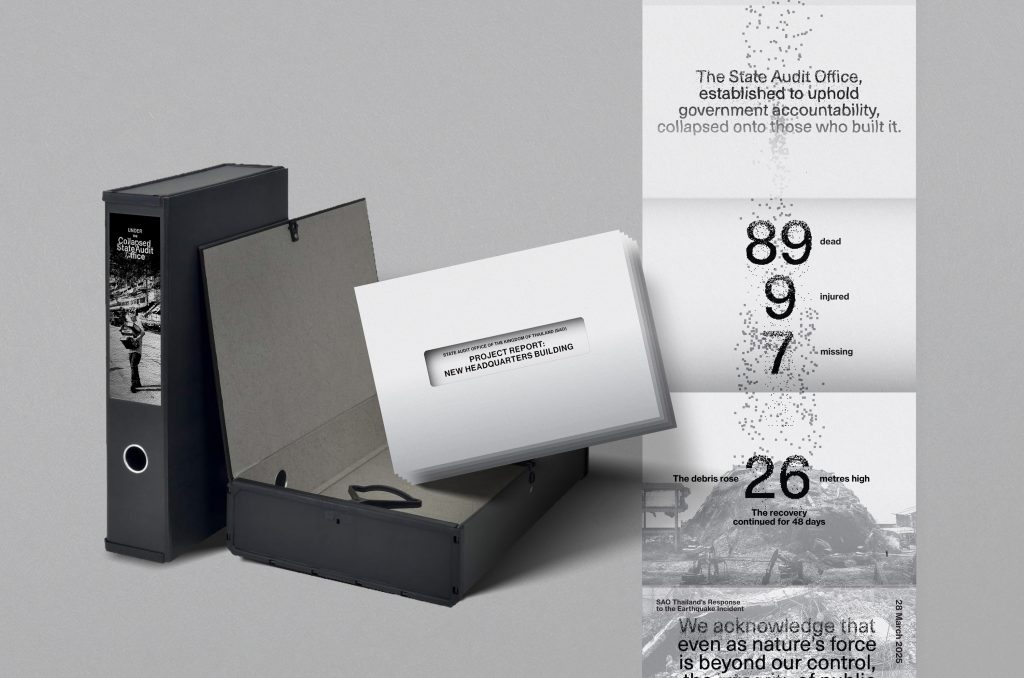
    Example of how I use graphic elements from a tool in layout and publication design.

    Example of how I use graphic elements from that tool in layout and publication design

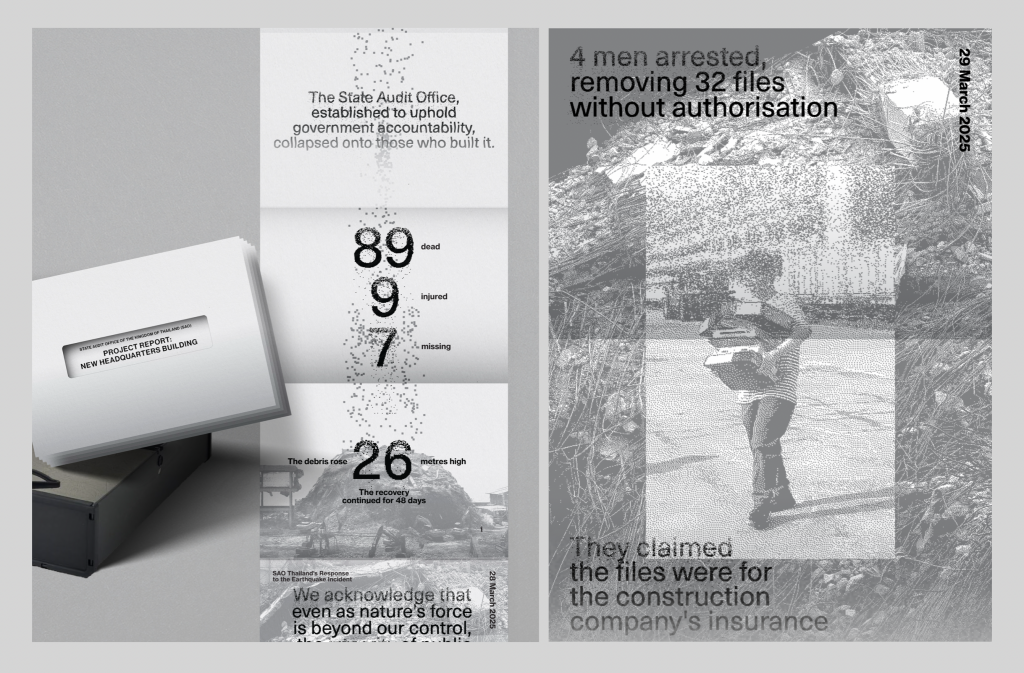
    This example from my publication investigates the earthquake in Thailand that caused a building to collapse. I found this approach effective for creating graphic components because it allowed me to develop a repeatable system that can be used across many visual elements, saving me from crafting each one manually. Using a generative tool also maintains consistency in the artwork and makes it easier to extend into other media in the future.


    The chosen tool

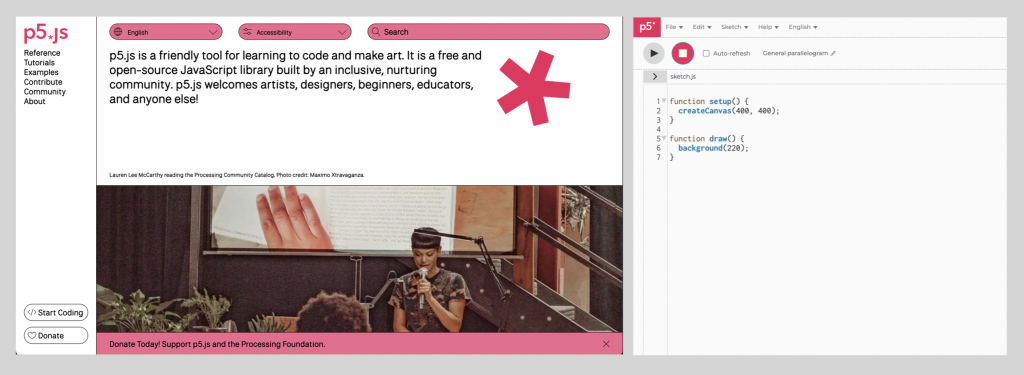
    That project ignited my curiosity about what I can achieve through creative coding. I aim to learn the fundamentals of coding and expand my skills using p5.js, a library and tool designed for learning coding and creating visual art.

    I believe learning to code will benefit me more than just vibing with AI. I’m also curious about how it uses language to produce visuals instead of drawing with vectors.

    The chosen project

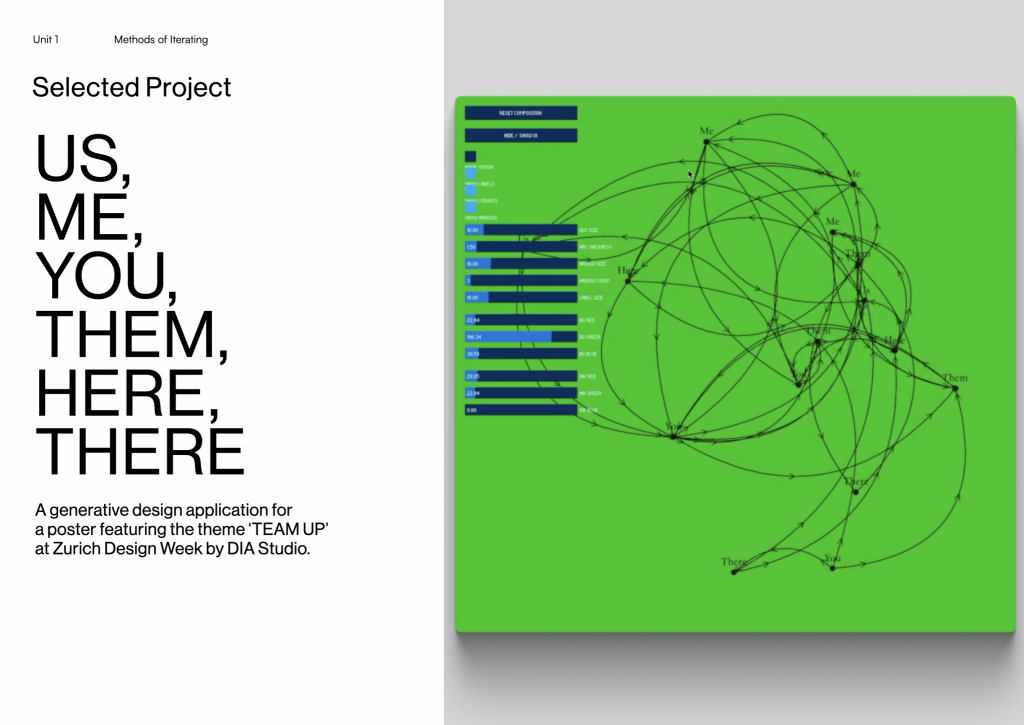
    The project I selected to replicate is a generative poster app created by DIA Studio. It demonstrates an effective way of using code to generate endless compositions. The app allows control over various parameters, such as line thickness, dot size, density, and motion, making it a valuable reference for me to learn how to draw basic lines and shapes programmatically and how a visual system can be managed through these controls. I plan to first replicate the visual output and then adjust the parameters. I’m unsure how difficult this will be and may not implement all functions, but I will do my best to complete it within one week.
    Reference

    Dia Studio (2025) Us, Me, You, Them, Here, There [Digital art]. Available at: https://www.instagram.com/p/DOeV-szEnZm/?hl=en&img_index=1 (Accessed: 15 January 2026).
  • Unit 1 Methods of Translating: Week 2(WIP)

    Unit 1 Methods of Translating: Week 2(WIP)


    As part of my translation method, I used AI (ChatGPT-5) to develop code that transforms the physical collapse of the State Audit Office building into a visual system app. The simulated vibration and falling of text and images translate architectural failure and the corruption within the nation’s accountability institution into a collapsing visual language. These visual elements were then incorporated into my publication.

    The process is documented in a playlist of seven videos. Although the code was primarily generated with AI assistance, I directed the translation process through prompts, decisions, and commands, beginning with a basic structure learned from a YouTube tutorial and refining it to align with my conceptual intentions.

  • Unit 1 Methods of Cataloguing: Week 2

    Bibliography

    American Historical Central (2025) A digital encyclopedia of American History. Available at: https://www.americanhistorycentral.com/entries/boston-tea-party/ (Accessed: 20 October 2025).

    Anderson, B. (2006) ‘Census, Map, Museum’ Imagined Communities. Verso.

    Chipstone (2024) Ceramics in America. Available at: https://www.chipstone.org/publications.php/2/Ceramics-in-America (Accessed: 19 October 2025).

    Cooper, W. (1993) Classical taste in America 1800-1840. Abbeville Press.

    Coysh, A.W. and Stefano, F. Jr (1981) Collecting Ceramic Landscapes, British and American Landscapes on Printed Pottery. Lund Humphries.

    Draper, A. (2021) Story of the Willow Pattern. Available at: https://vgm.liverpool.ac.uk/blog/2021/willow-pattern/?utm_source=chatgpt.com (Accessed: 19 October 2025).

    Fine Print (2025) History of City Hall in Pictures. Available at: https://www.history101.nyc/places/new-york-city-hall (Accessed: 23 October 2025).

    Gardiner Museum (2022) Working Conditions in the 19th-Century Staffordshire Potteries. 14 June 2022. Available at: https://www.youtube.com/watch?v=lB6-HqJajAs (Accessed: 24 October 2025).

    Harvard Library, Harvard University (no date) Artemas Ward House and Its Collections. Available at: https://curiosity.lib.harvard.edu/artemas-ward-house-and-its-collections (Accessed: 16 October 2025).

    Harvard University (no date) General Artemas Ward House Museum. Available at: https://wardhouse.harvard.edu/ (Accessed: 20 October 2025).

    Neale, G. (2005) Encyclopedia of British Transfer-Printed Pottery Patterns 1790-1930. Miller’s.

    SFO Museum (2016) from Print to Plate. Available at: https://www.sfomuseum.org/exhibitions/print-plate-views-east-transferware (Accessed: 19 October 2025).

    Sherwill, W. (1851) The Indian Opium, Its Mode of Preparation for the Chinese Market. James Madden.

    The Potteries (2025) Scriven’s Report on Child Labour in the pottery industry. Available at: https://www.thepotteries.org/history/scriven_index.html (Accessed: 24 October 2025).

    The Transferware Collectors Club (2025) Database of Patterns & Sources. Available at: https://www.transferwarecollectorsclub.org/members/database (Accessed: 19 October 2025).

    The Transferware Collectors Club, Winterthur Museum, Historic New England (no date) Patriotic America. Available at: https://americanhistoricalstaffordshire.com/ (Accessed: 20 October 2025).

    The Transferware Collectors Club, Winterthur, The Potteries Museum (no date) Spode Exhibition Online. Available at: https://www.thepotteries.org/history/scriven_index.html (Accessed: 24 October 2025).

    Victoria and Albert Museum (2025) An introduction to the Aesthetic Movement. Available at: https://www.vam.ac.uk/articles/an-introduction-to-the-aesthetic-movement (Accessed: 20 October 2025).

    Wikipedia Contributors (2019). Timeline of British history. Available at: https://en.wikipedia.org/wiki/Timeline_of_British_history (Accessed: 20 October 2025).

    Wood, E. (1827) A Representation of the Manufacturing of Earthenware. Ambrose Cuddon.

  • Unit 1 Methods of Investigating: Written Response

    Expanding on ‘Tension’ and ‘Conflict’

    After posting my written response, I realised I didn’t clearly explain what I meant by ‘tension’ and ‘conflict.’ I was referring to small shifts in atmosphere that occur when rhythms fall out of sync.

    For example, when people show consideration by speaking softly, tidying up, or being mindful of others, the atmosphere remains calm and balanced. On the other hand, loud arguing or leaving rubbish behind can alter the mood, and I often find myself quietly moving away to sit somewhere calmer.

    These subtle moments reveal how awareness and unawareness can reshape the atmosphere of a shared space, demonstrating that public environments are defined as much by human care as by their physical form.